
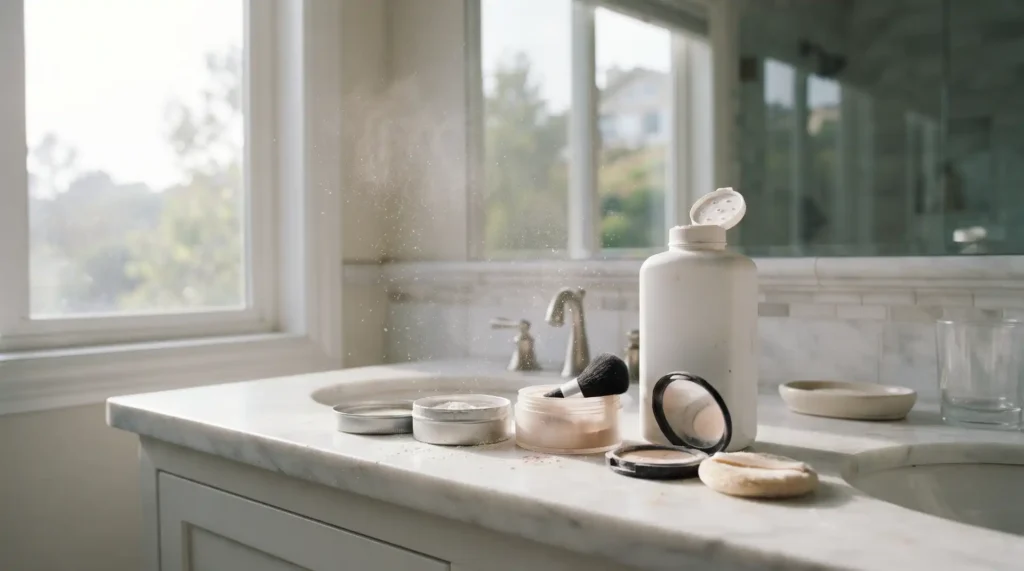
For decades, cosmetic talc has appeared in body powders, face powders, makeup, and other personal care products used in American homes. Most consumers gave little thought to where the mineral came from or how it was processed. That changed as questions about possible asbestos contamination became the subject of scientific investigations, regulatory attention, recalls, and product liability litigation.
For California consumers, the issue can be particularly significant when a person diagnosed with mesothelioma has no obvious history of working around asbestos. Attorneys investigating these cases may examine consumer products alongside traditional sources such as construction materials, shipyards, industrial equipment, automotive components, and secondary household exposure.
As of 2026, however, it is important to distinguish between talc itself and asbestos-contaminated talc. Asbestos is an established human carcinogen capable of causing mesothelioma. Talc deposits can occur near asbestos-containing rock, creating the possibility that asbestos may contaminate talc if the mineral is not adequately separated, processed, and tested.
This distinction matters medically and legally. A diagnosis of mesothelioma does not automatically prove that a cosmetic product caused the disease, and simply having used talcum powder does not establish a valid lawsuit. A successful claim generally requires evidence connecting a particular exposure history, product, defendant, and disease.
Why Cosmetic Talc Remains an Issue in 2026
Talc is a naturally occurring mineral valued for its softness and ability to absorb moisture. Cosmetic manufacturers have historically used it in products such as body powder, baby powder, pressed powder, eye shadow, blush, and other makeup.
The concern arises from geology. Talc and asbestos can occur in the same or neighboring mineral deposits. As a result, asbestos can potentially become mixed with talc during mining or processing.
The U.S. Food and Drug Administration explains that asbestos is a potential contaminant of talc and has conducted sampling programs involving talc-containing cosmetics. In an FDA testing assignment reported in 2020, asbestos was detected in nine of 52 samples, while later sampling rounds produced different results. FDA reported that asbestos was not detected in any of the 50 samples tested in 2021, any of the 50 tested in 2022, or any of the 50 samples included in its 2023 testing program.
Those findings should not be interpreted to mean that every talc product has been contaminated or that every product on the current market contains asbestos. They instead demonstrate why product-specific evidence and reliable testing matter when evaluating allegations involving older or current cosmetic products.
Regulatory developments have continued as well. The Modernization of Cosmetics Regulation Act of 2022 expanded FDA authority over cosmetics and directed the agency to establish standardized testing methods for detecting and identifying asbestos in talc-containing cosmetic products.
FDA proposed such a rule in December 2024. The proposal contemplated the use of analytical methods including polarized light microscopy and transmission electron microscopy. However, FDA announced on November 28, 2025, that it was withdrawing the proposed rule after receiving comments that warranted further consideration and assessment.
Therefore, consumers reading about the issue in 2026 should not assume the 2024 proposal became a final federal asbestos-testing rule. The regulatory process remains an evolving area.
Consumers who want current federal information can review the FDA’s information about talc and cosmetic safety.
 Why Asbestos Can Be a Concern in Talc Products
Asbestos refers to a group of naturally occurring fibrous minerals that were widely used because of their strength and resistance to heat. When asbestos-containing material releases microscopic fibers into the air, the fibers can be inhaled. Some may remain in the body for years or decades.
Mesothelioma is a rare cancer affecting the mesothelial tissue that lines certain internal organs. Pleural mesothelioma develops in the lining around the lungs and is the most common type. Other forms include peritoneal mesothelioma, affecting the abdominal lining, as well as much rarer forms involving tissue around the heart or testes.
The long latency period is one reason talc-related allegations can be challenging to investigate. Mesothelioma often develops decades after the relevant asbestos exposure. A California resident diagnosed today may therefore need to reconstruct product use reaching back into the 1960s, 1970s, 1980s, 1990s, or later.
A person may remember regularly using a body powder or makeup product but no longer have the packaging. The manufacturer may have changed formulations. Corporate ownership may have changed. Suppliers of raw talc may also have changed over time.
For these reasons, cosmetic talc litigation frequently involves a detailed historical investigation rather than merely proving that someone once used powder.
What Scientists Say About Talc and Cancer
The scientific discussion surrounding talc requires careful wording because talc and asbestos are not interchangeable substances.
In its most recent evaluation, the International Agency for Research on Cancer classified talc as probably carcinogenic to humans, Group 2A. IARC explained that asbestos can occur in some talc deposits and has been demonstrated as a contaminant in some talc products. Its evaluation considered evidence from human studies, experimental animals, and mechanistic studies.
IARC’s classification does not mean that every talc exposure will cause cancer. Hazard classifications identify whether an agent is capable of causing cancer under some circumstances; they do not determine an individual person’s risk from a particular product or exposure level.
For a mesothelioma claim involving cosmetics, an especially important question may therefore be whether asbestos or asbestos fibers were associated with the talc source or product allegedly used by the plaintiff.
How Cosmetic Talc Exposure May Occur
Exposure allegations differ from case to case. Some people report applying loose body powder to themselves every day for many years. Others may have worked as cosmetologists, barbers, makeup artists, salon employees, or professionals who repeatedly handled powdered products.
Using loose powder can create visible dust. Depending on the circumstances, particles may become airborne around the user’s face and breathing zone. A person applying powder to another individual may also be exposed.
Household exposure can add another layer. Family members might have shared the same bathroom or dressing area, cleaned surfaces where powder accumulated, or frequently been present during product application.
None of these circumstances alone proves exposure to asbestos. The key issue is whether an asbestos-containing or asbestos-contaminated material was actually involved and whether the exposure was legally and medically relevant to the person’s disease.
Cosmetic Talc Lawsuits Are Product-Specific
Headlines about talc litigation can make it seem as though all cases are essentially the same. They are not.
Some talc litigation has involved allegations concerning ovarian cancer, while other cases have alleged mesothelioma caused by exposure to asbestos in talc. These are different diseases, exposure theories, and medical causation questions.
A California mesothelioma case may require evidence showing what products the plaintiff used, how frequently they were used, when they were used, how the products were applied, where the talc originated, and whether evidence supports the presence of asbestos associated with the relevant product or supply chain.
Defendants may dispute one or more of those elements. They may challenge product identification, asbestos testing, mineral analysis, exposure estimates, medical causation, or whether their company supplied the product during the period claimed.
This is why broad statements such as “talc causes mesothelioma” can be misleading. A lawsuit depends on the evidence surrounding the specific claimant and alleged exposure.
Building a Cosmetic Talc Mesothelioma Case
Because mesothelioma may emerge decades after exposure, reconstructing history is often one of the most important parts of an investigation.
Product identification can begin with the patient and relatives. Family members may remember brands, container shapes, where products were purchased, or how they were used. Old photographs can sometimes show products in bathrooms, bedrooms, salons, or dressing areas. Receipts, catalogs, advertisements, store records, diaries, and other documents may also provide useful context.
The investigation may then extend beyond the finished cosmetic product. Lawyers and experts may examine historical records concerning manufacturers, raw talc suppliers, mines, corporate acquisitions, product formulations, testing procedures, and distribution arrangements.
Expert testimony can become important where mineralogy and medicine intersect. Depending on the dispute, specialists may evaluate pathology, occupational and environmental medicine, industrial hygiene, geology, microscopy, epidemiology, or other technical subjects.
Medical Evidence
A mesothelioma diagnosis is generally established through medical evaluation that may include imaging, pathology, biopsy results, and specialist review. Legal teams investigating causation commonly obtain medical records and pathology materials relevant to the diagnosis.
The person’s physicians and retained experts may also consider potential alternative sources of asbestos exposure. Someone who used talc products may also have served in the Navy, worked in construction, repaired automobiles, handled insulation, lived with an asbestos worker, or encountered older building materials.
A complete exposure investigation should therefore examine all plausible sources rather than focusing only on the source that initially appears most obvious.
Product Evidence
Original containers can be particularly useful when available because packaging may help determine manufacturer, product line, approximate date, ingredients, or lot information. Consumers should avoid altering or discarding potentially relevant products once litigation is being considered.
Even without the original container, other forms of evidence may be available. Testimony from relatives or coworkers can help establish recurring use. Historic advertisements, packaging records, formulation documents, and corporate records may help determine whether a product existed during the relevant period.
 Testing and Mineral Analysis
The scientific methods used to identify asbestos in talc have been a major regulatory and litigation issue. FDA’s 2024 proposed rule contemplated using both polarized light microscopy and transmission electron microscopy-based techniques. Although that proposed rule was withdrawn in November 2025, the scientific debate about sensitive and reliable testing remains relevant.
Testing results also have to be interpreted carefully. A test of one container manufactured recently does not necessarily establish what was present in a different product lot produced decades earlier. Conversely, evidence relating to an older sample does not automatically establish contamination of every product made under the same brand.
California Law Can Affect Talc Mesothelioma Claims
A California resident considering litigation must address more than medical causation. Product liability, negligence, corporate responsibility, jurisdiction, evidence preservation, and filing deadlines can all affect a case.
Asbestos cases also have unusual timing issues because of their long latency periods. California Code of Civil Procedure Section 340.2 establishes a specialized limitations framework for civil actions involving injury or illness based on asbestos exposure.
For personal injury claims, the statute refers to the later of one year after the plaintiff first suffered “disability,” as that term is defined by the statute, or one year after the plaintiff knew or reasonably should have known that the disability was caused or contributed to by asbestos exposure. The statute separately addresses asbestos-related wrongful death actions.
The application of these rules can depend heavily on the circumstances, including employment status, disability, knowledge, diagnosis, death, and prior asbestos-related disease. Consumers should therefore avoid assuming that a simple “one year from diagnosis” formula answers every California case.
Anyone facing a possible filing deadline should obtain advice based on the specific facts rather than relying solely on a general online limitations summary.
Potential Defendants in a Cosmetic Talc Case
A talc-related mesothelioma investigation may involve more than the brand name printed on the package.
Depending on the evidence, potentially relevant companies could include a finished-product manufacturer, talc supplier, mine operator, distributor, corporate successor, or another company involved in bringing the allegedly contaminated material into the stream of commerce.
Corporate history can make this complicated. A company operating under one name during the 1970s may have merged, sold assets, changed ownership, reorganized, or ceased operations long before a claimant receives a mesothelioma diagnosis.
Bankruptcy can also affect asbestos litigation. Numerous companies associated with historical asbestos exposure entered bankruptcy proceedings and established trusts to address qualifying asbestos claims. Whether an asbestos trust is relevant to a cosmetic talc claimant depends on the companies and exposure evidence involved in that person’s case.
Compensation Is Not Automatic
A person diagnosed with mesothelioma may face substantial medical and financial consequences, but a diagnosis by itself does not establish a right to compensation from a cosmetic manufacturer.
Where liability is proven or resolved through settlement, recoverable damages can depend on applicable law and the claimant’s circumstances. Issues may include medical expenses, lost income or earning capacity, pain and suffering, and other legally recoverable losses. Wrongful death claims can involve a different set of damages and eligible claimants.
Cases may end through negotiated settlements, jury verdicts, dismissals, or other procedural outcomes. Past verdicts or settlements involving talc manufacturers should not be treated as predictions of what another claimant will recover.
Every claim depends on its evidence.
Why a Person’s Entire Asbestos History Matters
Cosmetic talc may be only one part of a person’s lifetime exposure history. San Diego residents in particular may have encountered asbestos in industries and workplaces historically associated with the mineral.
Military service and maritime work are especially important subjects in Southern California asbestos investigations. Older Navy ships and facilities historically incorporated asbestos-containing insulation, gaskets, packing, boilers, pipes, machinery, and other components.
Construction workers, mechanics, electricians, plumbers, pipefitters, maintenance workers, and family members of asbestos-exposed workers may also have encountered fibers through occupational or secondary exposure.
A mesothelioma investigation therefore often develops a timeline covering jobs, military service, residences, household contacts, hobbies, building renovations, automotive work, and consumer-product use.
This comprehensive approach can help determine which exposures are supported by evidence and which companies may be associated with them.
 What FDA Testing Does and Does Not Tell Consumers
FDA testing provides useful information, but consumers should understand its limits.
In the agency’s 2019 sampling assignment reported in 2020, 43 samples tested negative and nine tested positive for asbestos. FDA later reported no asbestos detected in the 50 samples tested in each of its 2021, 2022, and 2023 assignments.
These programs involved selected samples rather than every talc-containing cosmetic sold in the United States. Results from a sampling program therefore should not be used to claim either that all talc cosmetics are contaminated or that no talc cosmetics have ever contained asbestos.
The results instead demonstrate the importance of careful testing, mineral identification, sourcing, and quality control.
FDA has continued to address cosmetic regulation through the Modernization of Cosmetics Regulation Act. Among other provisions, the law expanded FDA authority relating to facility registration, product listings, adverse-event reporting, records access, and certain recalls.
What the 2025 FDA Withdrawal Means in 2026
The status of the proposed asbestos-testing rule deserves special attention because outdated articles may still describe it as though final implementation were imminent.
FDA proposed standardized testing requirements in December 2024. The proposal would have established specific approaches for detecting and identifying asbestos in talc-containing cosmetics.
On November 28, 2025, FDA formally announced that it was withdrawing the proposal. According to the agency, comments submitted during the rulemaking process raised issues requiring additional consideration and assessment before final regulations are issued.
The withdrawal does not mean FDA concluded that asbestos contamination is harmless or impossible. FDA continues to identify asbestos as a known human carcinogen and recognizes potential contamination of talc as a consumer-safety concern.
For California consumers in 2026, the practical point is straightforward: distinguish between proposed federal requirements, withdrawn proposals, existing cosmetic law, voluntary practices, and any future final regulations.
California Proposition 65 and Asbestos
California consumers may also encounter cancer warnings under Proposition 65, formally known as the Safe Drinking Water and Toxic Enforcement Act of 1986.
Proposition 65 requires California to maintain a list of chemicals known to the state to cause cancer, birth defects, or other reproductive harm. Asbestos is among the substances addressed within California’s Proposition 65 regulatory framework.
A Proposition 65 warning should not be treated as proof that a particular product caused an individual’s mesothelioma. Similarly, the absence of a warning does not by itself resolve the factual issues involved in a product liability case.
Personal injury litigation requires its own analysis of exposure, causation, defendants, applicable law, and damages.
What California Consumers Should Do After a Mesothelioma Diagnosis
When someone is diagnosed with mesothelioma, preserving information about past exposure can become important because decades-old evidence may already be difficult to locate.
Patients and families may find it useful to create a chronological history of residences, jobs, military service, employers, coworkers, renovation projects, household members, vehicle repair activities, and regularly used powdered products. The goal is not to decide independently which source caused the disease but to create a record that can later be investigated.
Old photographs deserve particular attention. Family pictures sometimes capture products, work clothing, garages, tools, ships, workplaces, or building environments that help identify an exposure source years later.
Existing cosmetic containers, packaging, receipts, or other potentially relevant items should generally be preserved rather than cleaned, altered, tested privately, or discarded before obtaining appropriate guidance. Maintaining the condition and history of physical evidence can be important if experts eventually need to examine it.
Medical documentation should also be organized. Pathology reports, imaging, biopsy records, treatment records, and physician information may be relevant to both treatment and a potential legal investigation.
Can Family Members Bring Claims?
Mesothelioma affects entire families, and California law recognizes certain claims following a person’s death. However, who can bring a wrongful death or survival-related claim, which damages may be recoverable, and what deadlines apply are legal questions determined by California law and the facts of the case.
Asbestos-related wrongful death claims also fall under specialized California timing provisions. Families should not assume that the deadline for another type of injury lawsuit automatically applies to an asbestos case.
Where cosmetic talc is suspected, surviving family members may become important sources of factual evidence. A spouse, child, sibling, friend, or coworker may remember products that the patient used routinely even when the patient is too ill to provide a detailed history.
Why 2026 Is an Important Year for Cosmetic Talc Questions
The cosmetic talc issue continues to evolve at the intersection of science, federal regulation, product liability litigation, and consumer safety.
IARC’s updated evaluation has placed renewed attention on talc’s potential carcinogenic hazards. FDA continues to discuss the risk of asbestos contamination in talc-containing products, while its withdrawal of the 2024 proposed testing rule means the federal regulatory picture remains unsettled rather than complete.
At the same time, decades-long latency means new mesothelioma diagnoses can involve consumer products used many years ago. Modern testing results cannot automatically answer what was present in a product purchased several decades earlier.
These factors make careful historical investigation particularly important.
The Bottom Line for California Consumers
Cosmetic talc and mesothelioma lawsuits require more nuance than many headlines suggest. Talc and asbestos are different minerals, and not every talc product contains asbestos. Nevertheless, asbestos can occur near talc deposits and has been identified as a contaminant in some talc products. Asbestos exposure is a recognized cause of mesothelioma.
A California resident who develops mesothelioma after years of cosmetic talc use may therefore have reason to investigate that history, particularly when no obvious occupational exposure initially explains the diagnosis. That investigation should also account for military, industrial, construction, automotive, household, and other possible asbestos sources.
Ultimately, the viability of a cosmetic talc lawsuit depends on product identification, exposure evidence, scientific evidence, medical causation, responsible defendants, and California law. A diagnosis or history of talc use alone cannot establish liability.
Because asbestos cases can involve specialized filing rules and evidence that becomes harder to reconstruct with time, anyone evaluating a potential claim should obtain advice based on the specific facts of the exposure and diagnosis rather than relying on generalized claims about talc litigation.