

Mesothelioma litigation has always depended on more than simply establishing that a person has been diagnosed with cancer. In many cases, the central legal questions involve when and where asbestos exposure occurred, which products or companies may have contributed to that exposure, and whether the available medical and scientific evidence can reliably connect the disease to the exposure being investigated. These questions can be particularly challenging because mesothelioma often develops decades after asbestos fibers enter the body. By the time a diagnosis is made, a patient may have worked for several employers, lived in different communities, renovated older properties, or encountered asbestos-containing materials through multiple sources.
In 2026, developments in pathology, molecular testing, digital imaging, and laboratory analysis are changing how some of these cases are investigated. Newer methods can help pathologists examine tumor tissue, identify biological changes associated with mesothelioma, and distinguish malignant disease from certain noncancerous conditions. More advanced laboratory techniques may also help researchers detect disease-related molecular signals in smaller samples of tissue or fluid. These developments can make medical evidence more detailed and may help attorneys and expert witnesses explain complicated diagnostic findings.
However, scientific progress does not automatically establish legal responsibility. A laboratory result showing that a tumor has characteristics associated with mesothelioma does not identify the manufacturer of an asbestos-containing product. Nor does a molecular test necessarily establish the exact date, location, or intensity of a person’s exposure. California mesothelioma cases still require a careful investigation of medical records, occupational history, product identification, witness testimony, and the scientific basis for any expert conclusions.
Understanding the relationship between modern testing and courtroom evidence is therefore important for patients, families, attorneys, and anyone following asbestos litigation in California. The most significant changes are not simply that laboratories have more sophisticated equipment. They are that investigators may now have additional ways to evaluate disease, compare findings, and explain the medical evidence that forms part of a mesothelioma claim.
 Why Scientific Testing Matters in Mesothelioma Litigation
Mesothelioma is a cancer most commonly associated with asbestos exposure. It can affect the lining of the lungs, known as the pleura, and may also develop in the lining of the abdomen or other locations. The disease can take many years to appear after exposure. This long latency period creates substantial challenges for medical diagnosis and legal investigations. A patient may not remember every product encountered during employment decades earlier, and former employers or manufacturers may no longer have complete records. In some cases, witnesses who could describe workplace conditions may have retired, relocated, or passed away.
Medical testing is an important part of establishing what disease a patient has. Imaging studies may reveal abnormalities, biopsies provide tissue for examination, and laboratory tests help pathologists determine whether the cells show characteristics of malignant mesothelioma. These findings can become important evidence because a legal claim generally needs reliable medical support establishing the diagnosis and explaining the relationship between the disease and the alleged asbestos exposure.
Traditional diagnostic methods remain essential. A physician may use imaging to identify pleural thickening, fluid accumulation, masses, or other abnormalities. A biopsy may then provide tissue that can be examined under a microscope. Pathologists evaluate the appearance and arrangement of cells and may use immunohistochemical staining to identify proteins that help distinguish mesothelioma from other cancers. In many situations, a diagnosis depends on the combined interpretation of clinical information, imaging, tissue morphology, and laboratory results rather than a single test.
Modern scientific techniques add further layers to this process. Molecular pathology can identify changes in particular genes or proteins. Digital pathology can make it easier to examine, store, and compare tissue images. More sensitive laboratory methods may detect molecular material in samples that previously provided limited information. These methods can improve the quality of the medical investigation, but their results must still be interpreted within the context of the patient’s overall medical history.
For a California lawsuit, the distinction between medical diagnosis and legal causation is especially important. A medical expert may conclude that a patient has malignant pleural mesothelioma and explain why the findings support that diagnosis. A separate investigation must determine whether exposure to asbestos from a particular defendant’s product or premises contributed to the disease. The medical diagnosis is an important foundation, but it does not answer every question that must be addressed in litigation.
Advances in Pathology, Molecular Testing, and Tumor Identification
One of the most important developments in mesothelioma diagnosis is the growing use of more detailed molecular and immunohistochemical analysis. Immunohistochemistry, commonly called IHC, uses antibodies to identify particular proteins in tissue samples. Different tumors can have overlapping appearances under a microscope, so pathologists often use panels of markers to help determine the origin and nature of abnormal cells. In suspected mesothelioma cases, these tests can help distinguish mesothelial tumors from carcinomas and other malignancies that may involve the pleura.
IHC is not a single test that independently answers every diagnostic question. Pathologists generally consider multiple markers, the pattern of staining, the appearance of the tissue, and the patient’s clinical findings. Some markers support a mesothelial origin, while others may help identify alternative diagnoses. The interpretation can be especially complicated when a sample is small, damaged, or contains only a limited number of tumor cells. A carefully selected panel can provide stronger diagnostic support than relying on one isolated result.
Another important area involves the evaluation of BAP1, a protein associated with a gene that plays a role in regulating cell growth and other cellular processes. Loss of BAP1 expression in tumor cells can support a diagnosis of malignant mesothelioma in the appropriate clinical and pathological setting. It can be particularly useful when pathologists are trying to distinguish malignant mesothelial proliferation from certain benign conditions. Nevertheless, BAP1 loss is not present in every mesothelioma, and its absence does not automatically rule out the disease.
It is also important to distinguish changes found in tumor tissue from inherited genetic conditions. A tumor may acquire changes during its development that are not present in every cell of the patient’s body. In contrast, an inherited BAP1-related condition involves a germline genetic change that may be present throughout the body and can have implications for family members. A tumor-tissue result should not be casually described as proof that a patient inherited a cancer-predisposition condition. When inherited risk is a concern, appropriate genetic counseling and germline testing may be considered by the treating medical team.
MTAP testing and evaluation of CDKN2A-related changes are also relevant to mesothelioma pathology. MTAP is a protein that may be lost when certain neighboring genetic regions are deleted. CDKN2A is a tumor-suppressor gene, and deletion involving this region can provide additional evidence supporting malignancy in the right setting. These findings can be useful when the pathologist is evaluating whether a mesothelial proliferation is malignant rather than reactive or benign.
A further area of research involves 5-hydroxymethylcytosine, often abbreviated as 5-hmC. This molecule is associated with DNA modification and epigenetic regulation. Changes in 5-hmC patterns have been investigated as potential diagnostic clues in several cancers, including mesothelioma. Research published in 2026 has examined BAP1, MTAP, and 5-hmC as diagnostic markers in pleural mesothelioma. The study illustrates how researchers are evaluating combinations of markers rather than relying on one biological feature alone. The findings may contribute to future diagnostic approaches, although individual research results must be assessed in light of study design, sample size, validation, and clinical applicability.
For legal proceedings, these developments can affect how experts explain the diagnostic process. A pathologist may be able to describe why a particular combination of findings supports a diagnosis and why alternative explanations are less likely. Defense experts may examine the same findings and question whether the test was appropriate, whether the tissue sample was sufficient, or whether the interpretation is supported by accepted medical practice. The existence of a newer test does not eliminate disagreement. It may instead create more detailed questions for expert testimony.
The important point is that molecular and immunohistochemical tests are generally tools for evaluating the disease itself. They do not identify the asbestos-containing product that caused exposure, determine which company supplied it, or establish the legal responsibility of a particular defendant. Those questions require separate evidence.
Digital PCR, Fluid Testing, and Emerging Biomarker Research
Another developing area is the use of more sensitive laboratory techniques to examine biological samples. Digital polymerase chain reaction, or digital PCR, is designed to detect and quantify small amounts of genetic material. Unlike some conventional testing approaches that measure a signal across an entire sample, digital PCR separates a sample into many individual reactions. This can help researchers identify low-level molecular signals and may be useful when the available biological material is limited.
Researchers have investigated digital PCR and related methods for evaluating genetic changes associated with mesothelioma. Pleural fluid, which can accumulate around the lungs in some patients, may contain cells and molecular material that provide additional diagnostic information. Testing fluid samples may help supplement other investigations, particularly when a patient has a limited tissue sample or when clinicians are evaluating whether additional procedures are necessary.
A 2026 research publication indexed in PubMed examined digital PCR approaches involving BAP1 and MTAP in pleural fluid. Research of this type is significant because it explores whether molecular changes can be detected through samples that may be less invasive to obtain than a surgical tissue specimen. However, a promising research technique should not be confused with a universally accepted replacement for biopsy or established pathology. The clinical value of a test depends on its sensitivity, specificity, reproducibility, validation, and performance across different patient populations.
Biomarker research is also examining whether measurable substances in blood or other bodily fluids could help identify disease, monitor treatment, or provide information about changes over time. A biomarker may be a protein, genetic fragment, cellular component, or another measurable biological feature. Researchers have studied several potential biomarkers in mesothelioma, but no single blood test should be assumed to independently confirm or exclude every case.
Liquid biopsy is a broader term used for testing biological material found in fluids such as blood. Depending on the method, researchers may examine circulating tumor DNA, tumor-associated proteins, or other molecular signals. These approaches are attractive because they may allow repeated testing without requiring a new tissue biopsy each time. They may eventually help clinicians monitor disease progression or treatment response, although their use depends on the specific test and the evidence supporting it.
For litigation, fluid-based testing could become relevant when experts are asked to explain how a diagnosis was reached, how the disease changed over time, or whether a particular laboratory result is consistent with other medical findings. Attorneys may also need to examine the laboratory’s procedures, the chain of custody, sample handling, and the limitations described by the test manufacturer or research publication.
A test result is only as useful as the scientific process behind it. If a sample was collected improperly, stored under unsuitable conditions, contaminated, or analyzed using an unvalidated procedure, the result may be challenged. Experts should be prepared to explain what the test measures, what it cannot establish, and whether its use is accepted for the particular medical question being addressed.
 Imaging, Digital Pathology, Artificial Intelligence, and Advanced Laboratory Analysis
Imaging remains an important part of mesothelioma evaluation. CT scans can help physicians examine the chest, identify pleural abnormalities, and evaluate changes over time. PET-CT may provide additional information about metabolic activity, while MRI can be useful in selected circumstances when physicians need more detailed information about certain anatomical structures. These studies can help guide treatment decisions and provide context for pathology findings.
Advanced imaging does not independently establish every aspect of a mesothelioma diagnosis. Inflammation, infection, scarring, and other cancers can sometimes produce findings that overlap with those seen in mesothelioma. Imaging must therefore be interpreted by qualified medical professionals and considered alongside pathology, symptoms, examination findings, and other available information.
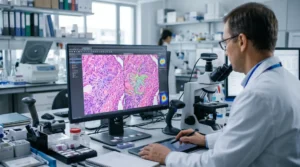
Digital pathology is changing how tissue samples can be reviewed and shared. In a traditional pathology workflow, a specialist examines glass slides under a microscope. Digital pathology systems can convert slide images into high-resolution digital files that may be viewed on computer screens. This can make it easier to share material with specialists, compare findings from different institutions, and preserve images for later review.
In a complicated mesothelioma case, a second pathology opinion may be important when the original findings are uncertain or when the diagnosis has significant implications for treatment. Digital slide files can support consultation between specialists, although image quality, scanning methods, and the limitations of the digital platform remain important. A digital image is not automatically a substitute for the original specimen, and a reviewer may need access to additional tissue sections or laboratory information.
Artificial intelligence is also being studied as a tool for analyzing pathology images and medical data. Some systems are designed to identify patterns that may be difficult to detect consistently through manual review. Researchers are exploring whether computer-assisted analysis can help classify tissue features, quantify staining, or identify areas that deserve closer examination.
AI systems should be understood as tools that may assist qualified professionals, not as independent authorities that determine a patient’s diagnosis or legal claim. A model may perform differently depending on the images used to train it, the equipment used to produce the images, and the patient population represented in the underlying data. If an AI-assisted result is presented in court, questions may arise about validation, error rates, transparency, reproducibility, and the qualifications of the expert interpreting the output.
Electron microscopy and specialized mineralogical analysis may also be relevant in selected asbestos investigations. These techniques can help researchers examine fibers or particles and characterize certain physical or chemical properties. Such analysis may be useful in occupational or environmental investigations when suitable samples are available. However, the presence of asbestos fibers in a sample does not automatically identify the company responsible for a patient’s exposure. Investigators must still establish where the material came from, how it was used, and whether the evidence connects it to the exposure history being alleged.
Taken together, these technologies can create a more detailed medical and scientific record. They may help experts explain what was observed, how the findings were obtained, and how different pieces of evidence fit together. They also create additional opportunities for cross-examination because opposing experts can examine the methods, assumptions, and limitations behind the conclusions.
How Scientific Evidence Connects to Asbestos Exposure and California Law
A mesothelioma lawsuit involves questions that extend beyond the medical diagnosis. A claimant may need to establish that exposure to asbestos occurred and that the conduct or product associated with a defendant contributed to the injury. In California, asbestos litigation has developed through statutes and court decisions addressing causation, product identification, premises liability, and the proof required to establish responsibility.
One important California decision is Rutherford v. Owens-Illinois, Inc. The case is associated with the substantial-factor approach to causation in asbestos litigation. In general terms, a plaintiff must present evidence that exposure to asbestos from a defendant’s product was a substantial factor contributing to the risk of developing the disease. The legal analysis is fact-specific and should not be reduced to the idea that any contact with asbestos automatically makes every manufacturer responsible.
This distinction matters because modern laboratory testing generally cannot reconstruct a person’s complete exposure history. A pathology report may confirm malignant mesothelioma, but it will not normally identify the brand of insulation installed at a particular job site in 1978. A molecular test may provide information about the tumor, but it does not establish whether the patient handled a particular manufacturer’s product or breathed dust released during a specific industrial operation.
Exposure investigations therefore continue to rely on evidence such as employment records, union documents, product labels, purchase orders, construction records, maintenance logs, safety manuals, photographs, and testimony from coworkers or family members. Former employees may remember working with insulation, gaskets, cement products, pipe coverings, brake components, or other materials that could have contained asbestos. Their recollections may be compared with historical product information and records from the relevant workplace.
Family members may also provide information about possible secondary exposure. In some circumstances, asbestos fibers brought home on work clothing or equipment may have exposed other household members. These cases require a careful investigation of the person’s relationship to the worker, the practices used to clean or handle work clothing, the time period involved, and the applicable legal requirements.
Scientific evidence can strengthen the medical portion of the case, while occupational and historical evidence addresses exposure. These categories should not be confused. A strong diagnosis does not automatically prove which company is responsible, and a detailed employment history does not replace the need for reliable medical evidence.
Expert testimony is often central to explaining these issues. A treating physician may discuss the patient’s diagnosis, symptoms, and treatment. A pathologist may explain the tissue findings and laboratory tests. An occupational medicine specialist or industrial hygienist may discuss exposure circumstances and the potential significance of asbestos-containing materials. Other experts may address product identification, workplace practices, or economic damages.
California Evidence Code sections 801 and 802 govern important aspects of expert opinion testimony and the basis for expert conclusions. California courts also consider the principles discussed in Sargon Enterprises, Inc. v. University of Southern California when evaluating the admissibility of expert opinion evidence. The court’s role is not simply to accept a conclusion because a witness has scientific credentials. The reasoning and foundation behind the opinion matter.
For example, an expert who relies on a new biomarker test may need to explain whether the test has been validated for the specific purpose for which it is being offered. If a test was developed primarily for research, its limitations may be important. An expert should distinguish between a scientifically promising method and a procedure that has become sufficiently established for a particular clinical or forensic use.
The same principle applies to digital pathology and AI-assisted analysis. An expert may need to explain how images were collected, whether the software was validated, and whether the conclusions can be independently reviewed. A computer-generated result should not be treated as automatically reliable merely because it appears precise or uses advanced technology.
Evidence Preservation, Conflicting Results, and Preparing a Mesothelioma Claim
Preserving evidence is important in mesothelioma litigation because the disease’s long latency period can make records difficult to locate. Medical records may be held by several hospitals, pathology laboratories, imaging centers, and treating physicians. Some older records may be stored in paper archives or transferred when a healthcare provider changes ownership. Tissue samples and pathology slides may also be subject to laboratory retention policies.
Patients and families should keep copies of available medical records, pathology reports, imaging reports, operative notes, treatment summaries, and relevant correspondence. If a second opinion is being considered, it may be helpful to ask the treating institution about the procedure for requesting pathology slides, tissue blocks, or digital images. These materials should be handled through appropriate medical and laboratory channels rather than removed or transported informally.
A legal investigation may also involve records that are not medical. Employment histories, tax records, military service documents, union membership information, Social Security earnings records, and workplace documents can help reconstruct a person’s occupational history. Family photographs, old work identification cards, product packaging, and correspondence may provide additional clues. Even small details can help investigators identify a worksite, employer, contractor, or product category that deserves further examination.
Conflicting medical test results do not necessarily mean that one laboratory made an error. Different tests may examine different biological features, use different sample types, or have different limitations. One sample may contain enough tumor tissue for a particular stain, while another may be too small or damaged. A molecular test may detect a change that is not present in every tumor cell. A pathologist may also reach a different conclusion after reviewing additional tissue or receiving updated clinical information.
When results conflict, the appropriate response is careful review rather than assuming that the most recent or most technologically advanced test must be correct. Physicians may consider additional testing, specialist consultation, or a review of the original material. In litigation, experts may explain why the results differ and whether the difference changes the overall diagnostic conclusion.
Patients should discuss the meaning of test results with their treating medical team. A legal article cannot determine whether a particular test is appropriate for an individual patient, and a research finding should not be used as a substitute for medical advice. Treatment decisions should be based on the patient’s clinical circumstances and the judgment of qualified healthcare professionals.
In a California mesothelioma claim, attorneys may review the medical diagnosis while separately investigating exposure history and potential defendants. The investigation may include identifying products, locating former coworkers, reviewing jobsite records, examining historical company documents, and determining whether other sources of asbestos exposure may be relevant. The objective is to build a reliable factual record rather than rely on assumptions based only on the type of cancer.
The location of a potential claim can also matter. A person diagnosed in San Diego may have worked in shipyards, construction, manufacturing, power generation, industrial maintenance, or other environments in different parts of California or outside the state. The relevant exposure may have occurred decades before the diagnosis and may involve more than one location. A thorough review should therefore examine the person’s complete work and residential history rather than focus only on where the patient currently lives.
Families may also need information about the types of compensation that could be available. Depending on the facts and applicable law, a claim may involve medical expenses, lost income, reduced earning capacity, pain and suffering, and other legally recognized damages. Certain claims may also involve wrongful death damages when a patient dies from mesothelioma. The available remedies and deadlines depend on the circumstances, and a qualified California attorney can explain how the law applies to a particular situation.
 What These Scientific Developments May Mean for the Future of Mesothelioma Trials
The direction of mesothelioma research suggests that diagnostic investigations will continue to become more detailed. Molecular pathology may help specialists characterize tumors with greater precision. More sensitive laboratory techniques may allow researchers to investigate biological material from smaller samples. Digital pathology may make specialist review easier, while AI-assisted tools may eventually support selected forms of image analysis. These developments could improve the quality of medical information available in some cases.
The courtroom impact, however, will depend on whether the methods are sufficiently reliable for the specific purpose for which they are offered. A test can be scientifically interesting without being ready to establish a diagnosis independently. A method that performs well in a controlled research study may produce different results in a broader clinical population. Courts and opposing experts may examine how a study was conducted, whether its findings have been independently reproduced, and whether the expert has applied the method appropriately.
Another likely development is greater attention to the difference between diagnostic certainty and exposure causation. As laboratory methods become more sophisticated, attorneys may have access to increasingly detailed information about the tumor. But the central exposure questions will remain: What material did the person encounter? Where did the exposure occur? Who supplied or controlled the product or premises? What evidence connects the defendant to the exposure? Did the exposure contribute to the disease under the applicable legal standard?
For patients and families, the most useful approach is to keep medical and legal investigations coordinated but distinct. Medical professionals should focus on diagnosis and treatment. Qualified experts should interpret specialized laboratory findings. Attorneys should investigate exposure history, identify potentially responsible parties, and determine which evidence is relevant under California law. No single laboratory result can replace this broader process.
Scientific progress can make mesothelioma evidence more informative, but the strongest cases will continue to depend on careful documentation, reliable expert analysis, and a clear explanation of how the evidence supports each required element of the claim.
Recent Scientific Research and Diagnostic Guidelines for Mesothelioma
Recent research published in Scientific Reports examines the diagnostic value of BAP1, MTAP, and 5-hmC markers in pleural mesothelioma (read the 2026 scientific study). Researchers are also exploring digital PCR as a method for detecting BAP1 and MTAP changes in pleural fluid samples (review the study on PubMed). For additional guidance on accurate mesothelioma diagnosis, see the international recommendations for the pathological diagnosis of mesothelioma.
Frequently Asked Questions About Scientific Testing and Mesothelioma Lawsuits
Can a new blood test diagnose mesothelioma in 2026?
Researchers are studying blood-based biomarkers and liquid biopsy methods that may provide useful information about mesothelioma. However, no single experimental blood test should be assumed to replace the established diagnostic process. Diagnosis generally involves clinical evaluation, imaging, pathology, and other testing selected by the treating medical team.
Can BAP1 testing prove that asbestos caused someone’s mesothelioma?
No. BAP1 testing may provide diagnostic information about tumor tissue and can help pathologists evaluate certain suspected mesotheliomas. It does not identify the source of asbestos exposure, establish which company supplied a product, or independently prove legal causation.
What is the difference between BAP1 and MTAP testing?
BAP1 and MTAP are different biological markers that can provide information about tumor characteristics. Loss of BAP1 expression and loss of MTAP expression may support a diagnosis of malignancy in appropriate circumstances. Pathologists interpret these findings alongside other stains, tissue appearance, and clinical information.
Can digital pathology results be used in a California mesothelioma trial?
Digital pathology images and related expert opinions may be relevant in litigation, depending on the facts and applicable evidentiary standards. Questions may include how the images were created, whether they accurately represent the tissue, whether the method is reliable, and whether the expert’s conclusions are properly supported.
Does a more advanced scientific test make a mesothelioma lawsuit stronger?
Not automatically. A reliable test may strengthen the medical evidence or help clarify a disputed diagnosis. A lawsuit also requires evidence addressing exposure, product identification, causation, and the responsibility of the defendant. The usefulness of a test depends on what it actually establishes.
How long after asbestos exposure can mesothelioma develop?
Mesothelioma often has a long latency period, and symptoms may appear decades after exposure. The exact interval varies. This delay is one reason why employment records, witness accounts, product information, and medical documentation can be important in an asbestos investigation.
Can a family member file a claim after a mesothelioma patient dies?
Certain family members or representatives of an estate may be able to pursue claims under California law, depending on the circumstances. Wrongful death and survival claims involve specific legal requirements and deadlines. A qualified attorney can review the facts and explain which options may apply.
Conclusion
New scientific testing methods are changing how mesothelioma is studied and diagnosed in 2026. Advances in immunohistochemistry, BAP1 and MTAP analysis, 5-hmC research, digital PCR, fluid-based testing, digital pathology, and AI-assisted image analysis are giving medical professionals additional tools for examining complex cases. These methods may help clarify diagnoses, support specialist review, and provide more detailed explanations of tumor characteristics.
For California mesothelioma litigation, however, the importance of these developments must be understood in context. Diagnostic tests can help establish what disease a patient has, but they generally cannot identify the asbestos product responsible for exposure or prove that a particular company should be held liable. Those questions still require a detailed investigation of work history, product use, jobsite conditions, historical records, witness testimony, and expert analysis.
The most persuasive cases will not necessarily be the ones with the newest laboratory technology. They will be the ones in which reliable medical findings are connected to well-documented exposure evidence and presented through clear, properly supported expert testimony. As scientific research continues to develop, patients and families should work with their healthcare providers on medical questions and seek qualified legal guidance when evaluating potential claims.